

11 Most Beautiful Places in Vietnam, According to The Times (P2: Central Vietnam)
Content []
11 Most Beautiful Places in Vietnam, According to The Times (P2: Central Vietnam)
Phong Nha-Ke Bang – Vietnam’s Cave Kingdom
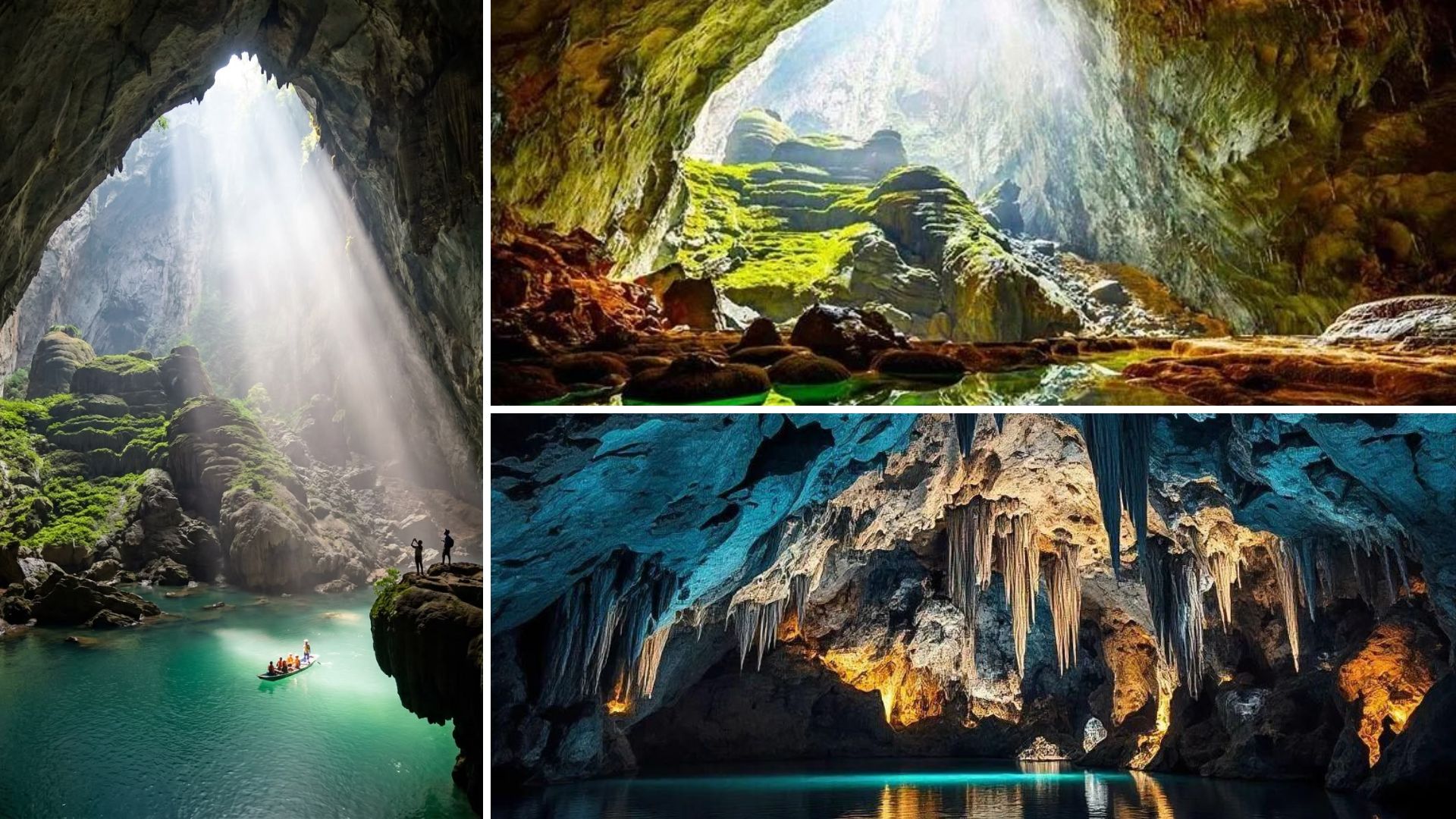
Hidden beneath the forested limestone mountains of Central Vietnam lies a world that feels almost untouched by time. Phong Nha-Ke Bang National Park is shaped by one of Asia’s oldest karst landscapes, where dense tropical forest covers the mountains above while an extraordinary network of caves, underground rivers and towering chambers stretches deep beneath the surface.
The adventure can begin gently at Phong Nha Cave, reached by boat along the emerald Son River before the journey continues into the darkness of the mountain. Inside, a calm underground river winds beneath enormous rock formations, while stalactites and stalagmites emerge from the shadows in spectacular shapes. Nearby, Paradise Cave feels even more monumental. Its vast chambers, soaring ceilings and elaborate formations have earned it a reputation as an underground palace sculpted entirely by nature.
Then there is Son Doong, the giant that transformed Phong Nha into one of the world’s great adventure destinations. Recognized as the largest known natural cave in the world, it is so immense that sections contain their own underground river, jungle and unique microclimate. Sunlight pours through enormous collapsed openings in the ceiling, allowing vegetation to flourish hundreds of metres beneath the mountains and creating scenes that seem almost impossible to exist underground.
Above the caves, the beauty continues with jungle-covered limestone peaks and clear waterways such as the Son and Chay rivers, their turquoise and emerald shades cutting through the green landscape. It is this contrast between what lies above and the mysterious world hidden below that makes Phong Nha-Ke Bang extraordinary: a place where entering a mountain can feel like stepping into an entirely different planet.
Hue – Vietnam’s Imperial City
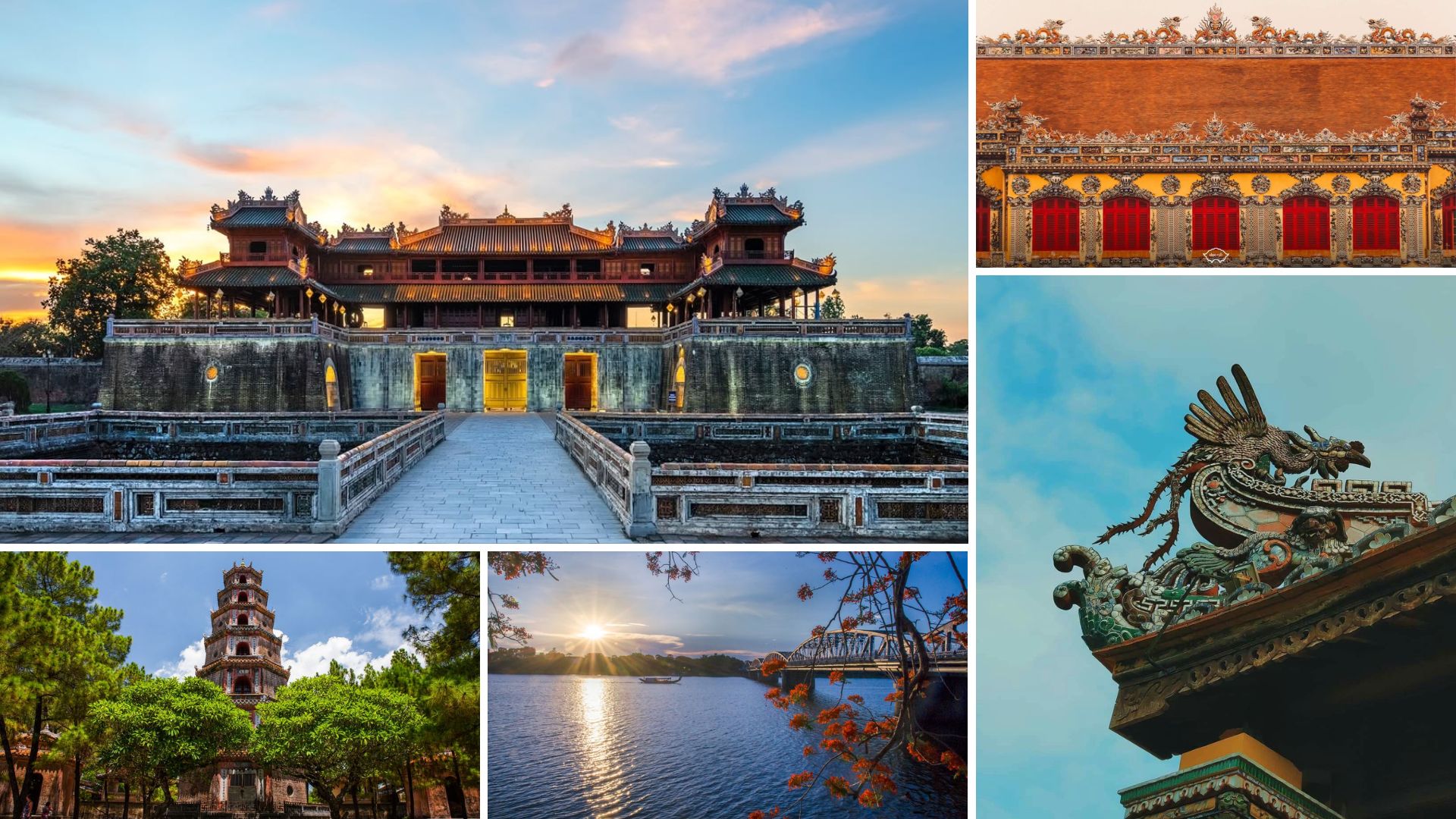
There is a quiet elegance to Hue that feels different from almost anywhere else in Vietnam. Once the imperial capital of the Nguyen Dynasty, the city still carries echoes of its royal past through moss-covered walls, tree-lined streets and ancient monuments resting peacefully beside the Perfume River. At its heart stands the Hue Imperial City, where the imposing Ngo Mon Gate, Thai Hoa Palace and courtyards of the former royal complex offer glimpses into an era when emperors once ruled from behind these walls.
Beyond the citadel, Hue’s royal heritage spreads into the surrounding countryside through the tombs of the Nguyen emperors, each with a personality of its own. Tu Duc’s tomb feels romantic and poetic among pine trees and tranquil lakes; Minh Mang’s is grand and carefully symmetrical; while Khai Dinh’s surprises with its elaborate fusion of Eastern and Western architecture. Ancient pagodas add another layer of serenity, from the seven-storey Thien Mu Pagoda overlooking the Perfume River to Tu Hieu Pagoda hidden quietly among pine forests.
And then there is the Huong River, flowing gently through the city beneath the silhouette of Ngu Mountain. In spring, particularly from February to April, mild weather, fresh greenery and blooming flowers make Hue especially graceful. Yet much of its beauty comes from atmosphere rather than any single landmark: the sound of traditional Hue royal court music, an evening performance of Hue folk songs drifting across the river, and the unhurried rhythm of daily life.
Even the food carries traces of Hue’s remarkable past. Simple local favorites such as bun bo Hue, banh beo and banh khoai sit alongside intricate dishes influenced by imperial cuisine, often prepared with almost artistic attention to detail. Together, its palaces, royal tombs, temples, river, music and cuisine make Hue more than a former imperial capital. It is a city where history still seems to move quietly through everyday life.
Son Tra Peninsula – The Green Side of Da Nang
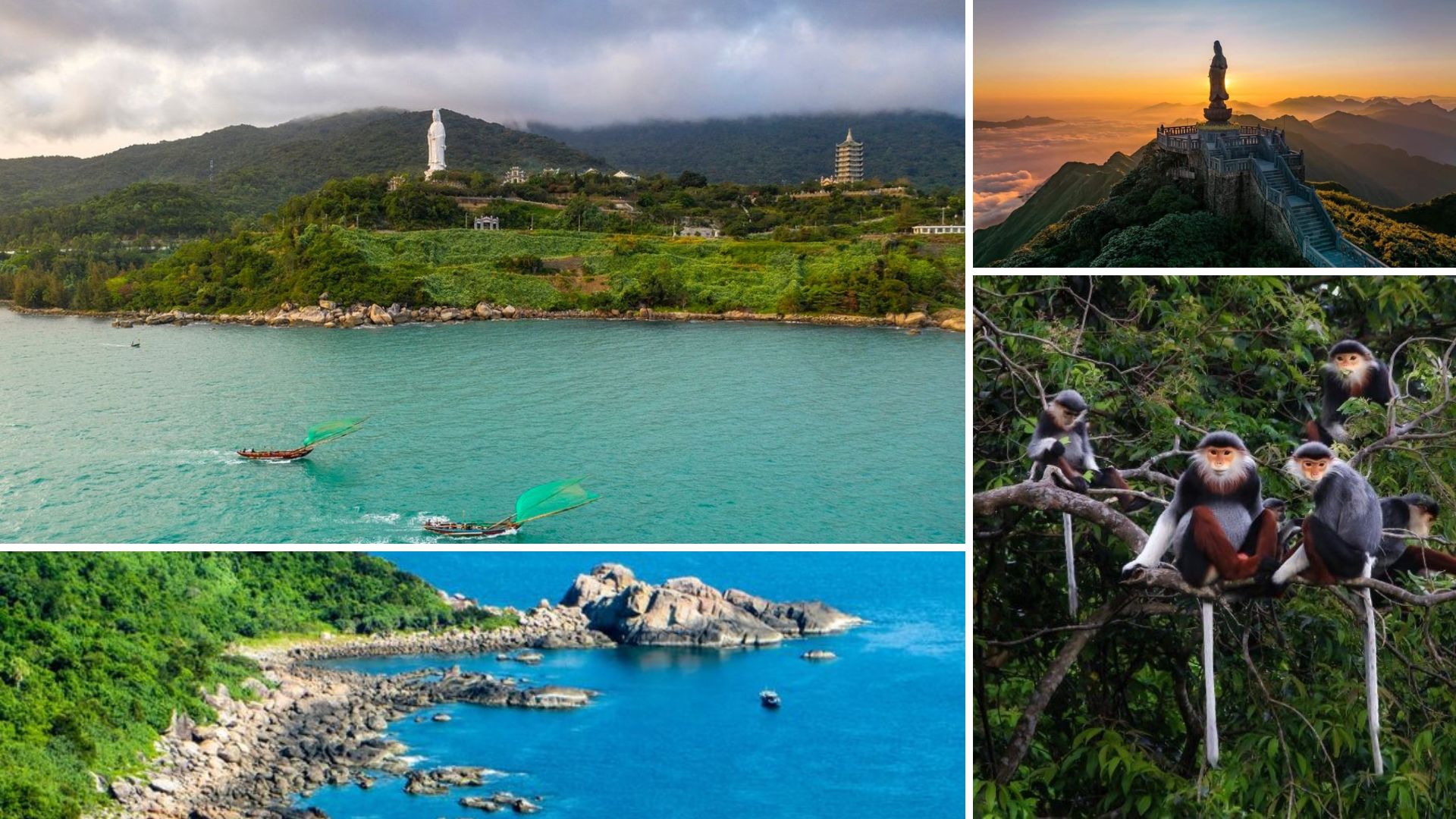
Rising between the mountains and the sea, Son Tra Peninsula is the wild, green side of Da Nang. From afar, its forest-covered slopes stretch into the blue waters like a natural embrace around the coastline, creating a landscape where mountains, jungle and ocean seem to flow effortlessly into one another. The scenery changes with the light: soft pink skies appear over the sea at sunrise, while late afternoon turns the bay golden and sends warm light through the forest canopy.
Venture deeper into Son Tra and the energy of the city quickly fades away. Mountain roads wind beneath dense tropical trees, the air becomes cooler and the soundtrack shifts to rustling leaves, birdsong and waves breaking against the rocky coastline far below. Ancient trees covered in moss rise above the forest floor, while viewpoints along the peninsula reveal sweeping stretches of blue sea and the city of Da Nang in the distance.
But perhaps the most enchanting residents of this green sanctuary are the red-shanked douc langurs, one of the rarest and most colorful primates in the world. Often called the “queen of primates” for their striking appearance, they can sometimes be spotted moving quietly through the treetops in the early morning. Their presence is a reminder that Son Tra is more than a beautiful viewpoint overlooking Da Nang. It is a living forest, where wildlife still thrives just beyond the edge of one of Vietnam’s busiest coastal cities.
With jungle-covered mountains on one side and the endless sea on the other, Son Tra offers a rare feeling of wilderness without leaving Da Nang far behind. It is this unexpected meeting of forest, wildlife and ocean that makes the peninsula one of the most captivating natural landscapes along Vietnam’s central coast.
My Son Sanctuary – Ancient Cham Heritage
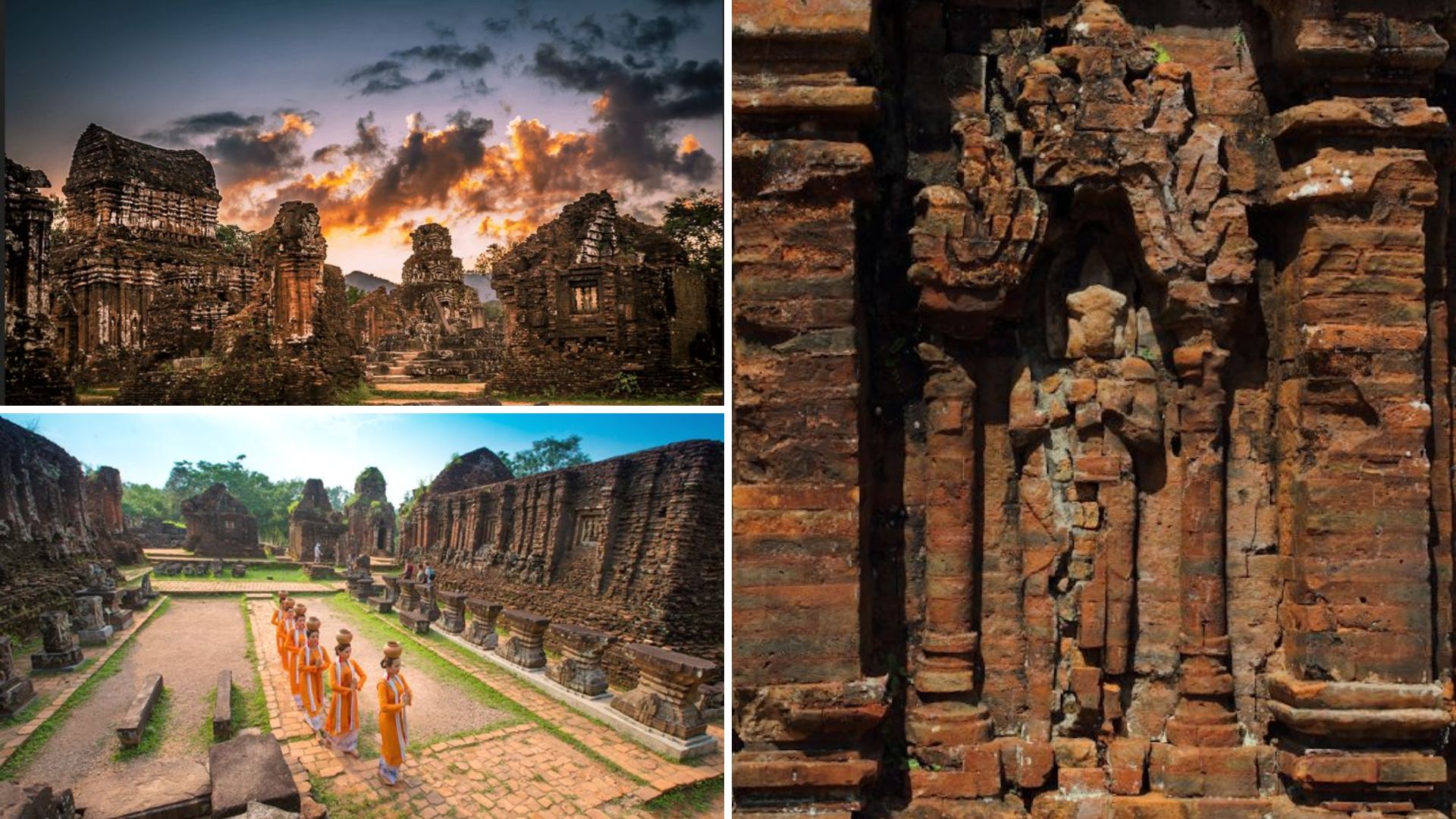
Hidden within a lush valley in Central Vietnam, My Son Sanctuary carries a beauty that feels ancient, mysterious and deeply spiritual. Recognized as a UNESCO World Heritage Site in 1999, the sanctuary was once an important religious and political center of the Champa Kingdom. Today, its weathered red-brick towers rise quietly against forest-covered mountains, giving the entire valley the atmosphere of a civilization slowly being reclaimed by nature.
The architecture is what makes My Son truly remarkable. More than 70 temples and towers were originally built here across different periods of Cham history, revealing several distinct architectural styles. Many were constructed from tightly fitted fired bricks with joints so fine that the original building techniques have fascinated researchers for generations. Despite centuries of tropical weather and the damage of war, surviving towers still preserve intricate stone carvings, sacred linga, images of Shiva and decorative details that reveal the extraordinary craftsmanship of the ancient Cham people.
Nature makes the ruins even more atmospheric. My Son lies within a secluded valley surrounded by mountains and dense greenery, far removed from the bustle of nearby cities. Visit in the early morning or late afternoon and sunlight slips through ancient doorways, casting long shadows across red brick walls and illuminating carvings that have survived for centuries. In the quiet between the towers, it is easy to understand why this landscape was once considered sacred.
The heritage of My Son is not frozen in stone, either. Traditional Apsara dances, accompanied by the rhythms of Paranung drums and Saranai music, bring elements of Cham culture back to life among the ruins, while festivals and rituals continue to preserve traditions passed through generations. With ancient towers, mountain scenery and living Cham culture woven together, My Son feels less like a collection of ruins and more like a doorway into one of Vietnam’s most fascinating ancient civilizations.
South Central Coast – Vietnam’s Scenic Coastal Road
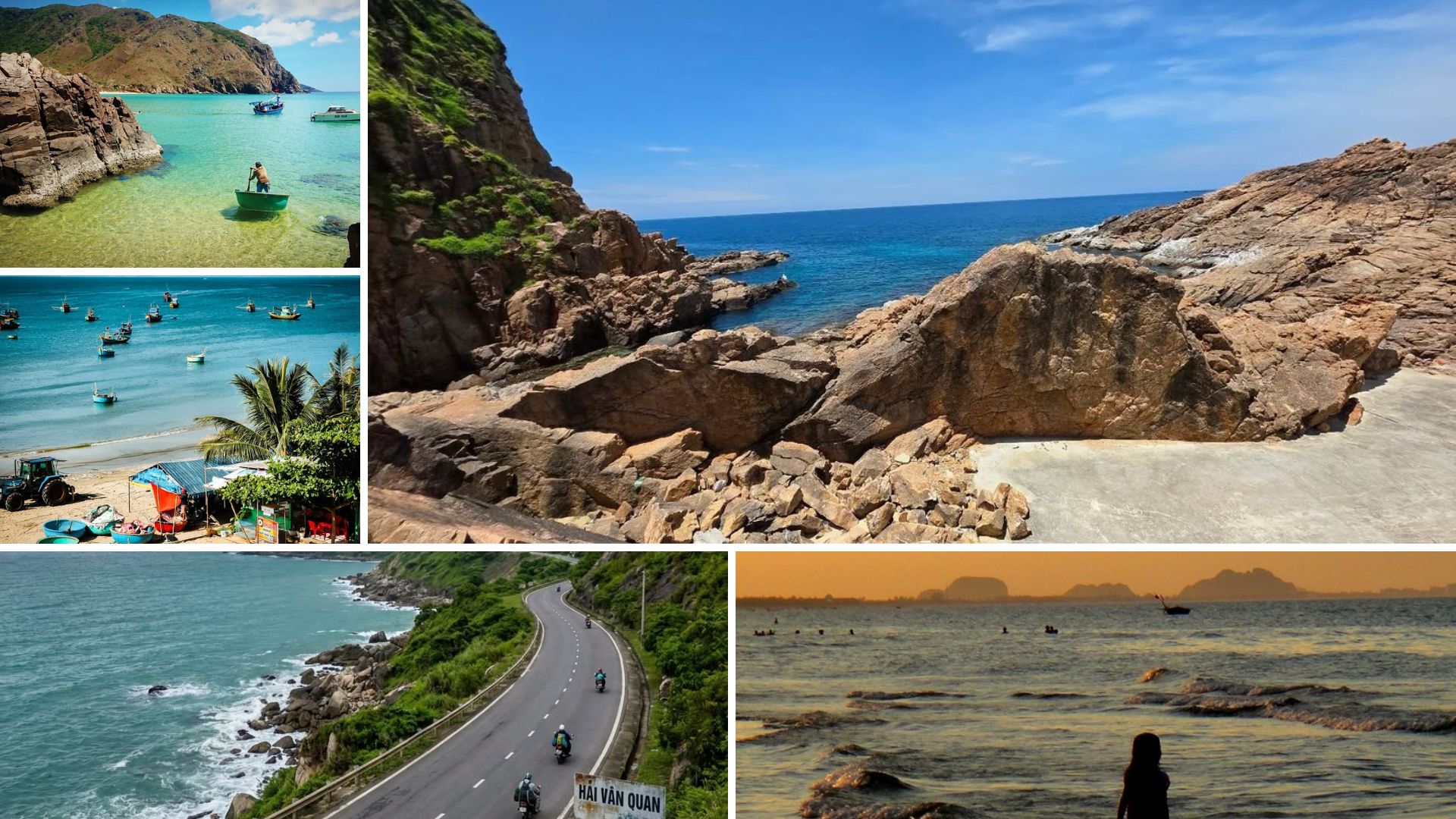
Stretching along Vietnam’s South Central Coast, the road from Quy Nhon towards Phan Rang is less about reaching a single destination and more about everything that unfolds along the way. Here, the landscape feels wide, sunlit and wonderfully untamed, with the scenery constantly shifting between blue ocean, rocky headlands, fishing villages and windswept sand dunes.
Perhaps the most striking sight is where the sea seems to meet the desert. On one side, waves roll towards long stretches of coastline in brilliant shades of blue; on the other, golden sand dunes rise beneath the tropical sun. The contrast becomes especially dramatic around the drier landscapes of Ninh Thuan, where immense dunes and rugged hills sit surprisingly close to the sea. Hidden among them are unusual rock formations, quiet coves and occasional freshwater lakes, little pockets of green appearing where you least expect them.
Yet the beauty of this coastal road also lies in its simplicity. Away from the busy traffic of Highway 1A, the journey passes sleepy fishing communities, empty beaches and stretches of road where the ocean seems to follow you for kilometres. Fishing boats gather in sheltered bays, sea breezes sweep across the road and small villages offer glimpses of a slower rhythm of life shaped by the coast.
Scattered along the journey are also traces of Central Vietnam’s long history, from ancient architecture to spiritual sites overlooking the landscape. Together with the wild coastline, these weathered landmarks give the route a quieter, more reflective character. With ocean, dunes, villages and history constantly changing outside the window, the South Central Coast turns the road itself into the destination, making it one of Vietnam’s most memorable journeys by the sea.
Read this next


Dong Van Stone Plateau recognised as world geopark
Quick Contact
Reviews from Customers
Please take a look at the following reviews from our customers
Mr Clarence- Travel President, Philippines
Vietnam | 01/14/2026
Luxury Golf Tour in Da Nang, 5days
Hi Jimy, We returned home safely today. I would like to say a special thanks to you and your team ACT TRAVEL. We really loved and satisfied with your pro services. We do love these golf courses in Da Nang. They were amazing and fantastic quality and view. We will come back here soon. I am looking foward to working together with you soon! Best regards, Mr Clarence- Travel President, Philippines
Mr. Jean Pie
United Kingdom | 10/13/2014
RAM Holidays from UK (Impressive of Vietnam 15 days)
Mr. Jean Pie – Tour Leader said “Thank you very much for doing such an excellent job on the tour. You went above and beyond for all of us and we really appreciate all your hard work. Thank you for your calm leadership through the “HAIYAN” storm, you really help us through it. Thanks to ACT Travel, we had a wonderful time and unforgettable memory”.
Mr. Navy Vang
Australia | 10/13/2014
Mandarin Group from Australia (Charming Vietnam 10 Days)
Mr. Navy Vang - Tour manager from Australia said: " Wow what a great vacation !. Thank you Mr Kelvin Pham so much. We are very grateful for everything you did for us and everything went very well. We’re safe and sound back home thinking about the joy we experienced. I've already decided that when I choose to travel again, I will go through your company. I also highly recommend ACT Travel Travel to any organization looking for a great agency. Kind regards
Mr. Ricardo - Program Manager
Brazil | 03/31/2014
DOMINGOS Group from Brazin (IMPRESSIVE VIETNAM 17 DAYS.)
Mr. Ricardo - Program Manager said “Dear Kelvin, Thanks you very much for your well arrangement. Thank you for the updated weather information. I have traveled a lot as a geography professor and dealt with many tour operators. You are one of the best tour operators who can take so much concern and care about customers. I must congratulate you on your good organization and care to minute points. Thanks for the mobile phone you provided to us and SIM cards you provide to all of us (29 cards, I know they are not cheap), it was an excellent convenience for us. It was a brilliant idea and we really appreciated knowing there was someone we could contact at any time should we need to. We love your welcome dinner at Binh Quoi village, where we enjoyed rich traditional southern Vietnamese cuisine with musical accompaniment provided by local folk musicians. We were very interested in the traditional Vietnamese wedding in Binh Quoi and we never forget the “Gong show” in Buon Me Thuot. Once again, thank you very much for great job”.
Ms. Barbara Betts
Australia | 10/13/2014
Orbiz Group from Australia (Discover Vietnam and Cambodia 15 Days)
Ms. Barbara Betts - Escorted guide from Australia said: " Dear Kelvin I want to take this opportunity to thanks you for providing us with superb guides in Vietnam and Cambodia. Well, Manh - tour guide in Vietnam is very professional and knowledegable and you can feel very safe in allowing him to guide your tours. The drivers you provided were also friendly, capable and they too did everything for the group to be happy Thanks you Kelvin so far for a fabulous tour.
Mr. Dany
Malaysia | 10/13/2014
Teachers Group From Malaysia ( Hanoi – Halong bay – Ninh Binh 6 Days )
Mr. Dany - Escorted guide from Malaysia said: " Hi Kelvin Pham, Thanks for arranging a great trip. I wanted to let you know how pleased we were with the itinerary and all the arrangements you organized. Everything worked extremely well and went exactly as planned. The guides were very knowledgable. My favorite site was cruising on the Halong bay. The hotels were great as they were located at the heart of city. We did enjoy eating at the local restaurants as arranged by ACT. The foods were sometimes unusual, but still tasty. I loved “Pho Hanoi“ very much and I would try to cook at my home… Thanks again
Mr. Ohad
Turkey | 10/13/2014
Istmaz Group from Turkey (Saigon - Mekong Delta - Cambodia - Angkor Wat 12 Days).
Mr. Ohad - The Tour Leader said: " On behalf of the entire group, I just wanted to thank both of you for all your help and outstanding execution in making our trip memorable! The entire group could not say enough great things about how well organized & smooth everything went. I really enjoyed Vietnam & Travel. Both tour guides were terrific and Angkor Wat was just amazing! All your arrangements worked out very smoothly and I consider the pilgrimage to be a great success ".
Mr. Steven
United Kingdom | 10/13/2014
Ponila Group from UK (Higlight of Vietnam 16 Days).
Mr. Steven - Escorted guide from UK said: Our trip to Vietnam was overall a positive one. We were very happy with the level of accommodation and quality of the food at all times. We love Hanoi but Ha Long Bay is certainly one of the most beautiful places we have ever seen; the old city in Hoi An has great potential becoming a world-class tourist attraction; and citadel in Hue embodies a great deal of historic signifance, we have a lot of photos in Hue. Cruising on Mekong Delta river was so interesting and Dalat highland was very romantic. Finally, please give our thanks to the tour guides Mrs Phuong, Mr Ky and the drivers who accompanied us throughout, always accommodating to the group's requests and last minute changes in itinerary. We won't forget you!
Mr. Barrick
United States | 10/13/2014
Global Alliane Group From USA (Discover Vietnam – Cambodia 10 Days)
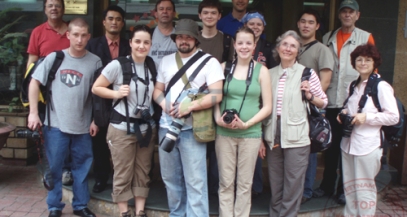
Mr. Barrick - the Tour Leader said: " Dear ACT Team,This is to thank you, and all of those who organised and guided our visit to Vietnam & Cambodia, for a superb holiday. We had a trip of a life time. Everything we were promised happened and more. We brought back so many memories and stories. The restaurants were wonderful and the hotels were great. Mr Nguyen had such a lot of knowledge he shared with us, and had a great sense of humor. He even knew of some Cambodian slang words. The whole trip will be something we will always remember and share with our family and friends. Thanks for all your help in making it so enjoyable. We shall tell all our friends traveling to Indochina that they must use ACT Travel's services !! ".
Partner





ACT VIETNAM TRAVEL
No 3, Alley 25, Dich Vong Hau Str, Cau Giay Dist, Hanoi Capital, Vietnam
sales@vietnamtraveland.com - jimy@vietnamtraveland.com - vip@vietnamtraveland.com
License: 01-639/2015/CDLQGVN-GPLHQT
Company
Term of use
Payment Methods


